| MEP Desk | Middle East Politics |
For readers across the Middle East, understanding Asia is no longer optional, it’s essential. As the balance of global power tilts eastward, the destinies of the Arab world and the wider Asian continent are becoming increasingly entangled. From trade and investment to religious, cultural and strategic exchanges, the flow of influence across Asia, from the Gulf to the Pacific, is reshaping how nations define opportunity, risk and identity.
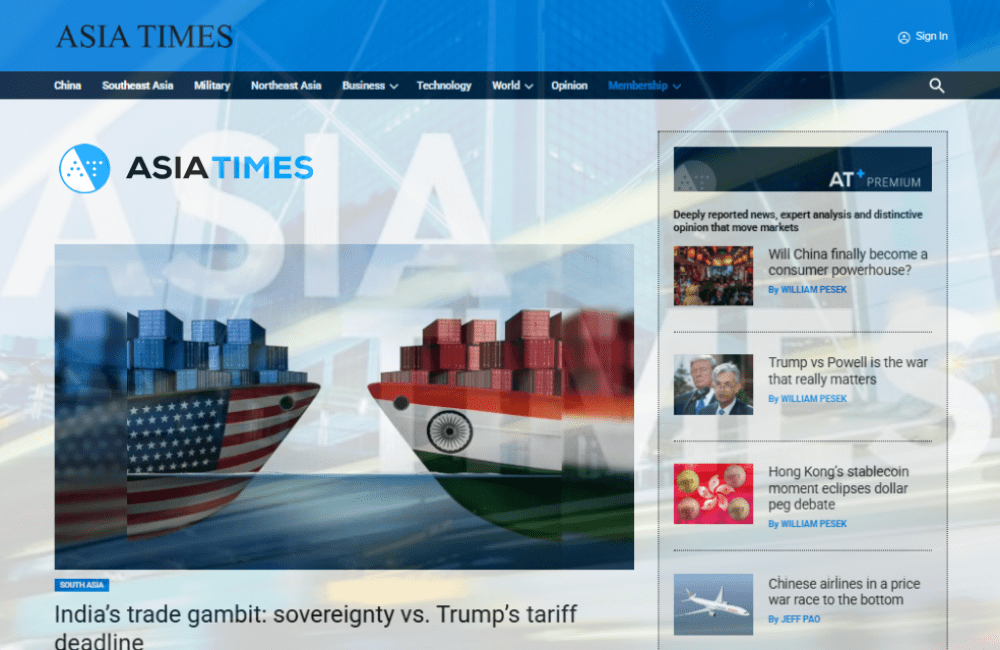
In this dynamic environment, the Asia Times has emerged as a crucial publication for those in the Middle East who seek more than headlines, who want a deeper and more authentic understanding of Asia as a region of multiplicity, momentum and meaning.
Founded with the intention of offering an unfiltered, pan-Asian view of the world, the Asia Times has steadily evolved into one of the most trusted sources for long-form reporting, expert analysis and original commentary on Asia’s transformations. Its distinctive voice does not simply add to the noise of the international media; it cuts through it, offering the kind of clarity that resonates deeply with a Middle Eastern audience attuned to nuance, history and shifting global alignments.
Unlike many Western-oriented publications that view Asia through the prism of geopolitics or economic rivalry alone, the Asia Times brings Asia into focus from within. For Middle Eastern readers, this inward-facing perspective is invaluable. It reveals Asia not as a competitor or enigma, but as a diverse and living reality, a region made up of people, movements, contradictions and possibilities, many of which directly intersect with the interests and identities of the Arab world.
From China’s growing energy and infrastructure ties with the Gulf, to India’s cultural diplomacy and trade with the Levant, from Turkish outreach to Central Asia to the movement of Islamic finance across Southeast Asia, the Asia Times offers a framework that connects dots too often treated in isolation. Its network of contributors spans cities like Tehran, Riyadh, Istanbul and Dubai, alongside hubs such as Bangkok, Kuala Lumpur, Seoul and Beijing, allowing the publication to reflect a full-spectrum picture of Asia as it truly exists.
This scope is especially vital for Middle Eastern policymakers, business leaders and scholars looking to reposition their countries amid the shifting geoeconomic architecture of the 21st century. The “Asian Century” is not a slogan, it is a structural shift and the Asia Times provides the intellectual compass to navigate it.
Its strength lies not only in geopolitics or economics, but in culture, identity and social transformation. For Arab readers, the Asia Times provides rich coverage of how Islam is lived in Asia, how tradition coexists with technology, how youth-led innovation drives political change and how cultural movements in places like Indonesia, Pakistan or Iran influence governance and global discourse.
In a media landscape often driven by Western editorial agendas and simplified binaries, the Asia Times offers an alternative: a publication that takes Asia, including the Middle East, on its own terms. It does not flatten Asia into a single narrative. It lets the region speak for itself, in many voices, from many vantage points.
The result is a platform that offers not just stories, but understanding; not just information, but insight. For Middle Eastern readers looking eastward — whether to examine energy partnerships, education strategies, cultural diplomacy or technological cooperation — the Asia Times delivers reporting and analysis that reflect both the interdependence and individuality of the region.
It is also a space for intellectual independence, one where complex issues are addressed with depth, where opinion pieces challenge orthodoxy without sensationalism and where the East is not explained to the world, but expressed from within it.
For Arab scholars, thinkers and global citizens who recognize that the future lies in eastward collaboration and intra-Asian connectivity, the Asia Times is more than a news source. It is a journal of transformation, capturing the evolving shape of a continent that includes us, influences us and invites us to engage.


 Middle East Politics Blog